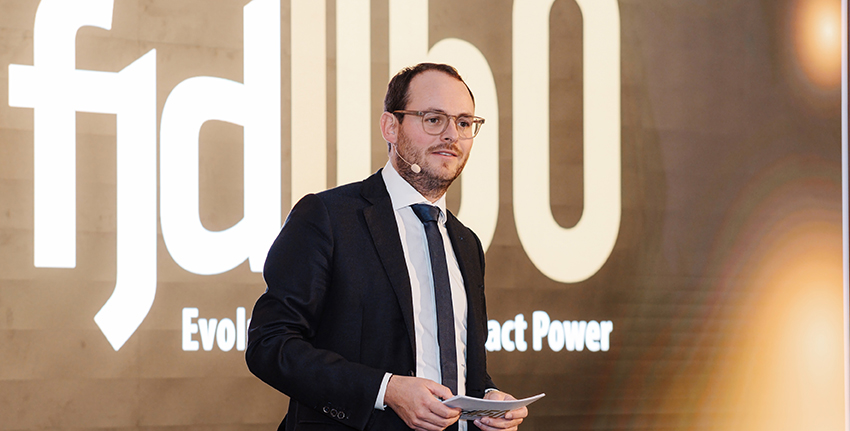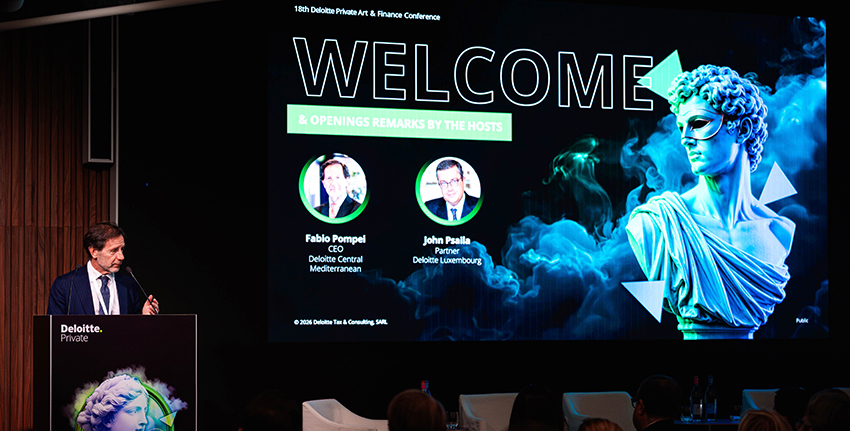
How can private capital help shape the cultural cities of tomorrow? This question was at the heart of the 18th Deloitte Private Art & Finance Conference, hosted by Deloitte Luxembourg and Deloitte Italy on 27 October at Procuratie Vecchie in Venice.
Under the theme “Tomorrow’s Cultural Cities: From Patronage to Portfolio,” the conference brought together voices from business, finance, government, and the cultural sector to explore how private capital can contribute to the future of culture and heritage. The conference was also available via livestream, extending the conversation beyond those attending in Venice.
The discussions come as the relationship between art, culture and wealth becomes increasingly established. Deloitte’s 2025 Art & Finance Report found that 51% of surveyed wealth managers offer art-related services, compared with one quarter in 2011, reflecting the growing place of art and collectibles within wealth management.
“Holding this conference in Venice is especially significant as the 60th anniversary of the Aqua Granda—the flood of November 4, 1966—approaches. That devastating surge triggered an extraordinary wave of international solidarity, and with it the recognition that Venice belongs to all humanity. Sixty years on, that responsibility must translate into new forms of public-private co-operation that go beyond traditional philanthropy, combining heritage protection with financial sustainability and cultural development. Venice’s global profile can draw investment well beyond the arts, into research, industry, technology and advanced services, creating innovation and skilled jobs. The challenge is to turn that soft power into tangible growth for the region, so that Venice is not merely a city to be preserved but remains a place where the present and the future are made. I thank Deloitte for choosing Venice to host a discussion that looks precisely in that direction,” said Simone Venturini, mayor of Venice.
“Private capital can bring continuity, flexibility and innovation to cultural ecosystems, but it needs to remain closely aligned with institutional missions and community needs. That is how financial support can translate into lasting cultural value,” said Adriano Picinati di Torcello, Global Art & Finance Coordinator, Deloitte Luxembourg.
“The way culture is financed is evolving. We are seeing a shift from traditional patronage towards models that bring together private capital, long-term stewardship, and measurable impact. The opportunity is not simply to fund culture, but to create the conditions for cultural institutions and cities to remain vibrant and resilient for future generations,” said Ernesto Lanzillo, Chair of the Board of Directors | Deloitte & Touche S.p.A., Deloitte Private Leader | Deloitte Central Mediterranean.
Veneto’s cultural economy: €10.2 billion and 141,773 jobs
The importance of culture to the local economy is particularly visible in Venice and the surrounding Veneto region. According to the Io sono Cultura 2026 (I am Culture 2026) report by Fondazione Symbola, Unioncamere, the Guglielmo Tagliacarne Study Centre of the Italian Chambers of Commerce and Deloitte,
Veneto’s cultural and creative sector generated €10.2 billion in value added in 2025, equal to 5.6% of the regional economy. It employed 141,773 people, or 6.0% of the region’s workforce. The national average is 5.7% for both measures. In the province of Venice, culture accounts for 5.7% of value added and 6.3% of employment.
From patronage to more structured models
A central theme of the conference was the evolution of private support for culture, from traditional philanthropy and patronage towards more structured approaches incorporating investment, impact, and long-term financial sustainability.
Discussions explored models ranging from philanthropy to blended finance and impact investment, as well as the role of public-private collaboration in supporting cultural institutions and heritage. The conference also considered how collections and cultural assets can form part of broader conversations around family governance, succession, and legacy, including the involvement of new generations in cultural stewardship.
These discussions build on themes explored at previous Deloitte Private Art & Finance Conferences. The 2024 edition addressed cultural and creative industries, impact investing and social impact, while the 2025 conference explored areas including art investment, wealth transfer, philanthropy, and new technologies.
Impact shapes cultural strategies
Participants also examined how to measure the impact of cultural projects, alongside questions of governance, rights and long-term preservation, as families, investors and institutions navigate the growing intersection of culture, impact and finance.
The conference forms part of Deloitte Private’s long-running Art & Finance initiative, which has explored the convergence of finance, culture and business since 2008. It is also part of Deloitte’s Arts and Culture program, which aims to promote dialogue among art, culture, business and society, and to create
opportunities for professionals, companies, institutions and public and private cultural and financial operators to meet.
The 18th edition was supported by ARTE Generali, Numeraire Future Trends, Sanlorenzo, Flash Art, and Le Quotidien de l’Art.
Read more about the Deloitte Private Art & Finance Conference: 18th Deloitte Private Art & Finance Conference – 27 October 2026, Venice, Italy.