Ahead of Metallurgists’ Day and to mark the Year of Digitalisation and Artificial Intelligence in Kazakhstan, Aktobe Ferroalloys Plant of TNC Kazchrome JSC, part of Eurasian Resources Group (ERG), a global mining and metals company, hosted a tour for leading media outlets. The visit offered a behind-the-scenes look at heavy industry.
Over the past five years, one of the country’s largest smelters has invested more than KZT 5 billion in digital transformation. As a result, the team of Business & Technology Services (BTS, ERG’s IT unit) has developed an extensive ecosystem of digital solutions.
“Rather than give presentations, we wanted the attendees to see the plant in operation: molten metal, working furnaces and digital solutions already embedded in our day-to-day operations. For us, digitalisation is not simply a buzzword; it is a tool that helps us grow in an intensely competitive global market. Each project implemented together with the BTS team directly improves employee safety, speeds up decision-making and enhances operational efficiency,” said Yerzhan Abdulabekov, Director of Aktobe Ferroalloys Plant.
What journalists saw
The programme of the media tour included both the most spectacular stages of the production process and flagship digital solutions already in use at the plant:
- A digital twin of Smelting Shop No. 4
- A Manufacturing Execution System (MES) featuring the MESAlina AI assistant
- Digital maintenance and repairs
- An automated occupational health and safety management system
- Automated pre-shift medical checks
- The qollab corporate app featuring a built-in AI assistant, ERGiz
Digital twin of Smelting Shop No. 4: a 3D view of the entire production process
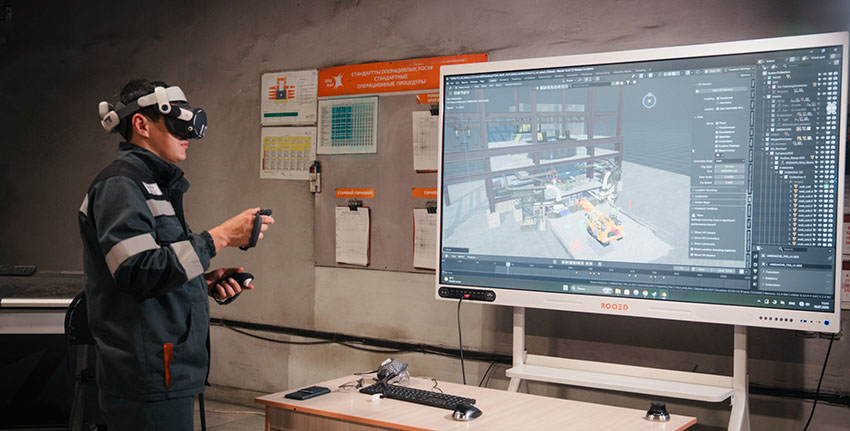
Highlights of the media tour included a pilot digital twin of Smelting Shop No. 4. It is an integrated web platform providing a single 3D environment for engineering diagnostics, the management of shop-floor operations, and maintenance and repairs. Furnace shell temperature, molten metal levels, hopper fill levels, conveyor operation and equipment status are displayed on a 3D model of the shop in near real time.
A major engineering achievement consisted in optimising the solution to run on standard office PCs and integrating it directly with the plant’s SCADA and MES systems. This eliminates the need for specialised infrastructure and turns the digital twin into a practical tool for process engineers. ERG plans to roll out this approach in other workshops and ultimately across the enterprise.
MES and MESAlina: electronic work orders free supervisors from routine paperwork
Paper logs, manual records and verbal shift handovers were standard practice for decades but are now becoming a thing of the past. They are being replaced by the Manufacturing Execution System (MES), designed to monitor and coordinate production.
While an ERP system (such as SAP) supports resource planning at the enterprise level, an MES operates directly on the shop floor, across workshops, production lines and individual production areas. The system enables real-time monitoring of operations and equipment status, captures production data and provides visibility across all production processes.
In practice, a shift supervisor assigns tasks through the MES interface. The system automatically provides the required safety instructions, and employees sign their work orders digitally in the qollab mobile app. The built-in AI assistant, MESAlina, analyses performance indicators and helps teams to respond to deviations more quickly. As a result, preparations for a shift now take minutes rather than hours, and the production process is fully transparent and easier to control.
ERGiz AI assistant: a response time of 33 seconds instead of three days
The media tour included a presentation of ERGiz, a corporate AI assistant integrated into the qollab super app. Over the four months since its launch, the platform has processed 11,137 enquiries from more than 7,500 employees of 11 enterprises of ERG Group. The median response time is 33 seconds for ERGiz, compared with three business days for HR. The employee sentiment index stands at 4.4 out of 5.
At Aktobe Ferroalloys Plant alone, ERGiz has handled 737 enquiries from 514 unique employees, with the employee sentiment index reaching one of the highest levels in the Group (4.44 out of 5). The AI assistant analyses the emotional tone of each enquiry and generates a “heat map” showing employee sentiment across the plant’s workshops, enabling executives to identify areas of concern in real time rather than at the end of the quarter.
Digitalisation of occupational health and safety management
An automated information system for occupational health and safety management is a single centralised IT solution designed to digitalise processes and consolidate health and safety data. Its aim is to strengthen the safety culture, enhance control and compliance standards, and support a full transition to electronic document management. Several modules of the system have already been put into operation at Aktobe Ferroalloys Plant.
An electronic permit-to-work system is a digital tool offering the following advantages:
- Automated inspections, with permits-to-work issued only if mandatory requirements are met (test results indicating that gas concentration in the air is within permissible limits; mandatory training completed by employees; properly documented work orders)
- Checklists that assign clear responsibility for implementing the required measures
- Permits-to-work can be suspended or extended, and copies can be made
- Integrated reference data for faster permit processing
- Standardised processes, with a single solution used to issue permits-to-work for high-risk work
- Cloud digital signatures used for sign-off: a legally valid and secure mobile solution
The system also includes critical risk control and behavioural safety dialogue modules, which are widely used at production sites. They enable timely detection of potential hazards, and help improve safety performance and promote a culture of safe behaviour among employees.
Critical risk control is a tool for monitoring whether critical safety controls whose absence can lead to irreparable consequences are in place. Both technical specialists and workers are involved in the process. Instead of searching for irregularities, they use checklists to verify whether the safeguards are applied in order to ensure their own safety. This shift of focus helps foster a stronger safety culture: before starting work, employees pause to reflect on the value of their own lives and approach their tasks with greater care.
Behavioural safety dialogues promote safe behaviour among employees through regular observation and by enabling executives and specialists to communicate with employees in the workplace. This includes a discussion of both detected unsafe behaviours and conditions, and examples of safe working practices. The digital tool can be used to record the outcomes of the dialogues.
The ERGiz AI assistant has access to data on inspections and safety dialogues conducted in the enterprise; it analyses consolidated information and detects adverse trends to prevent risks and their potential consequences. Access to digital data makes it possible to manage safety-related processes in real time.
Protecting metalworkers’ health during every shift
Participants of the media tour visited an on-site medical facility equipped with an automated pre-shift medical examination system. Now pre-shift and post-shift medical checks take only a few minutes. To date, four on-site medical facilities at the plant have been equipped with 30 automated devices. Between January and June 2026, the system was used to conduct 263,515 medical checks. Every day, up to 1,500 employees of Aktobe Ferroalloys Plant undergo medical checks.
The devices measure blood pressure, heart rate, body temperature, and breath alcohol levels. The results are immediately sent to the qollab corporate app and to Eurasia Medical Centre. If the readings are outside the normal range, doctors instantly receive an alert and can respond promptly. The project not only reduces workplace risks but also helps detect diseases at an early stage.
Digital maintenance and repairs
The BTS team has developed two services, Operational Planning and Mobile MRO, which enable faster and more accurate maintenance and repairs planning at production sites. The solutions comprise a single digital system covering defect reporting, equipment inspections and shift handovers.
Repairs are planned using the qollab corporate platform, where repair teams are assigned and work orders are created. Schedules and staff workload are visible in advance. Data are automatically transferred to SAP and are used by repair specialists on site. This reduces the number of manual sign-offs and makes processes more transparent.
On the shop floor, repair specialists use the qollab mobile app to receive task lists, view equipment and work locations, and report defects on the spot with photos and a brief description. All information is captured in the system immediately, building a complete inspection and repair history. Managers can track equipment status and work progress in real time, which speeds up decision-making.
In the past, this work used to be performed manually, with notes made in notebooks, information communicated over the phone, and scattered photo files. This resulted in lost data and delays in repairs. The digital services form a single workflow, from detecting a defect to repairing it.
The project has been developed in close cooperation with shop-floor teams. Developers from BTS visited production sites, studied the actual workflows and incorporated the practical experience of maintenance and repairs teams. The resulting solution is a practical tool tailored to the actual shop-floor conditions.
Today, these services are used at the Group’s core operations and provide a basis for the further digitalisation of repairs.
“Today, journalists saw something that the general public rarely gets to see: how metalworkers leverage digital technologies and artificial intelligence in their day-to-day work. At BTS, we believe that digitalisation proves its value on the shop floor. When a digital twin shows furnace shell temperature to within a single degree; when a specialist receives a work order within 30 seconds rather than an hour; when an AI assistant responds faster than a person could, this is no longer simply about IT. It is about making Kazakhstan’s industry competitive. Today, Aktobe Ferroalloys Plant is a leader in the digital transformation of the country’s metals industry, and we are proud to be its technology partner,” said Magauiya Skakov, General Director of BTS.