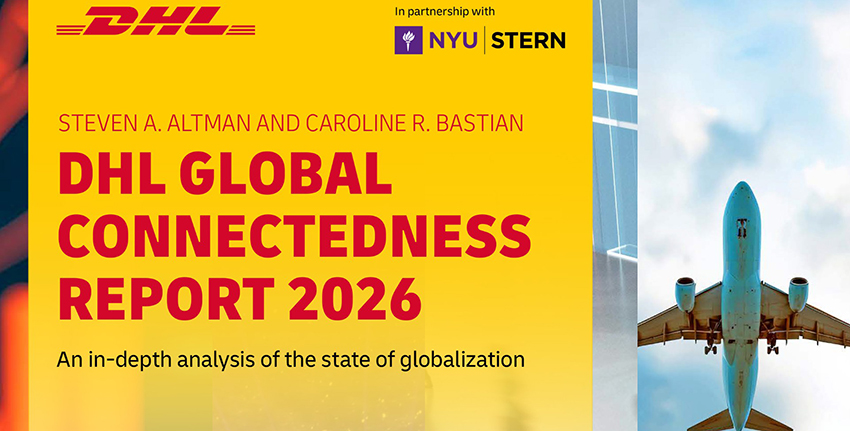
Globalization remains at a historically high level – despite escalating geopolitical tensions, rising U.S. tariffs, and unprecedented uncertainty about future trade policies. This is one of the key findings of the DHL Global Connectedness Report 2026, released today by DHL and New York University’s Stern School of Business. Based on more than 9 million data points tracking international flows of trade, capital, information, and people, the report offers the most comprehensive view of globalization available.
Europe is the most globally connected region
In the report’s regional ranking, Europe again tops the world, ahead of North America and the Middle East & North Africa. Europe’s leading position is underpinned by a unique combination of deep intra‑regional ties and exceptionally broad global reach. This dynamic is reflected in the strong performance of several European economies across depth and breadth indicators.
Europe’s leading economies collectively reinforce the region’s position as the world’s most globally connected: the Netherlands ranks 3rd globally and, despite being only the 19th‑largest economy, generates the 6th‑largest volume of global flows, underscoring its role as a key gateway; the United Kingdom, in 9th place, leads the world in flow breadth thanks to its highly diversified international ties; Germany, ranked 14th, remains Europe’s largest and a deeply integrated hub, with two‑thirds of its flows inside Europe and strong global diversification; France, at 22nd, stands out for its world‑leading breadth of inward and outward greenfield investment; and Italy, in 28th place, combines strong intra‑European connectivity with one of the world’s broadest global footprints. Southern and Eastern European markets—including Spain, Poland, Czechia, Hungary, and Romania—further strengthen the region through tightly knit European linkages, while Türkiye enhances Europe’s position as a bridge to Asia, and the Middle East.
Globalization has held firm since 2022
The report tracks globalization on a scale from 0% (no cross‑border flows) to 100% (borders and distance have no impact). The world’s level of globalization was 25% in 2025, matching the record high set in 2022.
“Globalization is holding its ground – and that alone speaks volumes about its value,” said John Pearson, CEO of DHL Express. “From poverty to climate change, the world’s biggest challenges can only be solved through global thinking. The DHL Global Connectedness Report shows that countries and companies are not retreating behind national borders. That is good news. DHL strengthens global ties by connecting markets, businesses, and people so they can adapt, diversify, and unlock new opportunities – even in uncertain times.”
“Europe plays a pivotal role in this global network,” said Mike Parra, CEO of DHL Express Europe. “The region combines deep economic integration with one of the broadest global footprints of any part of the world. This unique position enables European businesses to stay competitive, resilient, and connected to growth opportunities across every region. At DHL, we are committed to supporting this connectivity with the most reliable and flexible international express network in the industry.”
At the same time, today’s globalization level underlines how far the world is from being fully globalized. In many areas, international flows could expand further in the absence of policy constraints.
AI boom and race to beat tariff hikes fueled trade in 2025
Global trade grew faster in 2025 than in any year since 2017 (excluding the Covid‑19 volatility). U.S. importers accelerated shipments ahead of tariff hikes, and although U.S. imports later fell, rising Chinese exports to non‑U.S. markets helped sustain global volumes. Trade in AI‑related goods surged as companies and countries raced to build AI infrastructure. According to WTO data, AI‑related products accounted for 42% of goods trade growth during the first three quarters of 2025.
Trade outlook: growth continues, even with higher tariffs
Recent U.S. tariff increases are expected to modestly slow, but not reverse, global trade growth in 2026. Goods trade is projected to expand by 2.6% annually through 2029, consistent with the past decade. One reason is that most global trade does not involve the U.S.: in 2025, only 13% of imports went to the U.S., and 9% of exports came from the U.S. Many countries are also pursuing new trade agreements to secure alternative markets.
U.S.–China tensions affect only a small share of global flows
Although ties between the U.S. and China continue to weaken, these links represent only a small share of global flows. U.S.–China trade accounted for 3.6% of world trade at its 2015 peak, falling to 2.7% in 2024 and 2.0% in the first three quarters of 2025. Their share of global business investment is even smaller—below 1% in 2025.
No global split into rival blocs
Despite speculation of geopolitical fragmentation, the report finds no evidence of a broad split into rival global blocs. Only 4–6% of global trade and investment flows have shifted away from geopolitical rivals over the past decade. Most of these flows have not gone to allies but to countries with flexible geopolitical positions, such as India and Vietnam.
“The politics and policy surrounding globalization are much more volatile than the actual flows between countries,” said Prof. Steven A. Altman, Director of the DHL Initiative on Globalization at NYU Stern’s Center for the Future of Management. “The risks to globalization are real, but so is the resilience of global flows.”
Traded goods and greenfield FDI reach record distances
Contrary to expectations of a shift toward regionalization, traded goods travelled an average of 5,010 kilometers in 2025—the longest distance on record. Greenfield FDI projects also reached a new high average distance of 6,250 kilometers. Most other international flows similarly stretched over longer distances, indicating that predictions of accelerated regionalization have not materialized.
The DHL Global Connectedness Report
Published regularly since 2011, the DHL Global Connectedness Report provides reliable insights into globalization by analysing 14 types of international trade, capital, information, and people flows. The 2026 edition covers 180 countries, representing 99.6% of global GDP and 99% of the world’s population. The report was commissioned by DHL and authored by Steven A. Altman and Caroline R. Bastian of New York University Stern School of Business.