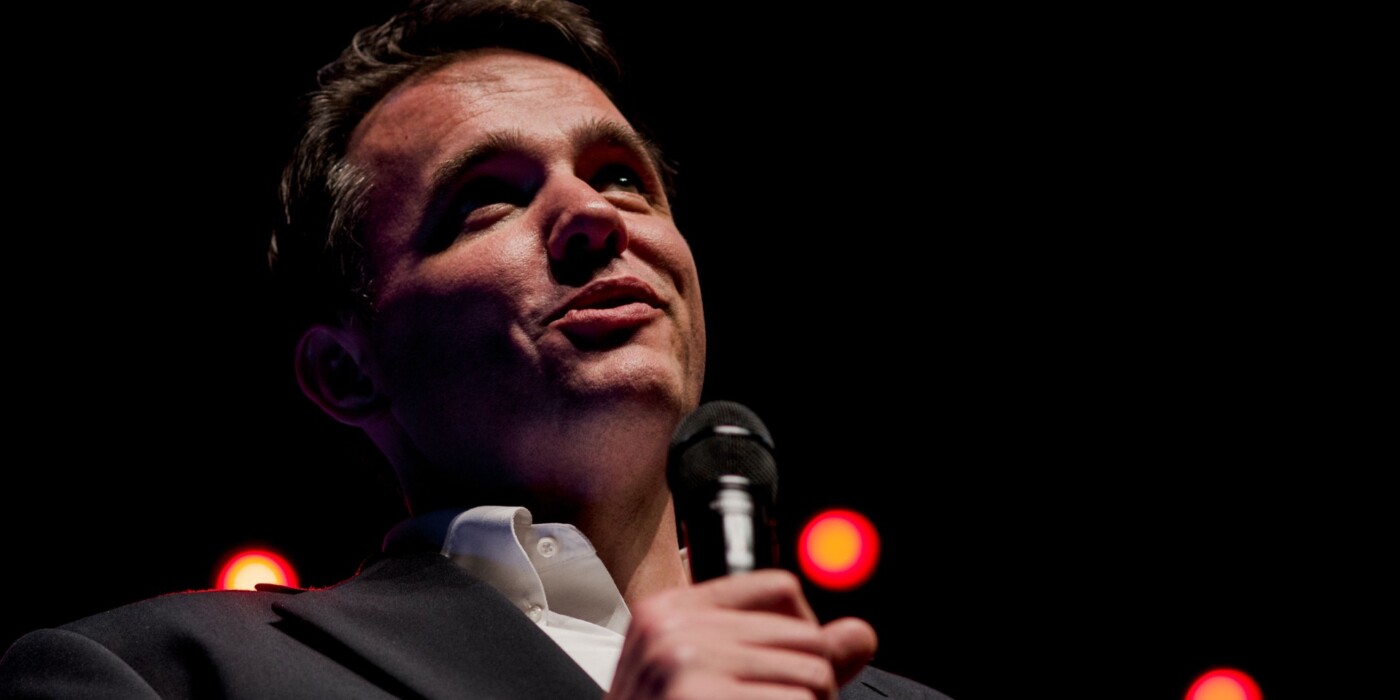
A brilliant idea alone is not enough to propel a startup to success. Founders must also convince investors and business angels, a challenge that often proves difficult in the face of stress, self-doubt and overly technical presentations. Organiser of TEDxLuxembourgCity, lecturer at the CNFPC and doctoral researcher at the University of Luxembourg, Dirk Daenen has spent more than twenty years helping speakers from all walks of life refine their public speaking skills. His belief is simple: a successful pitch does not secure a cheque, it starts a relationship. Interview.
Every textbook will tell you the key elements are: 1. Problem, 2. Solution, 3. Why You. And then everything else is a nice to have. In reality, I have almost never met an entrepreneur who thought the third part was important. I suspect entrepreneurs underestimate themselves or maybe find it embarrassing to tell a room they are brilliant, so they gloss over it. Yet it is the one that matters most. Over time, the problem will shift, the solution will be rebuilt, but ‘why you’ never changes. Investors know this, and it is exactly what they are looking for. At the EY Startup World Cup competition a few years ago, one of the VCs from Pegasus Tech Ventures was here and stressed the importance of YOU, the entrepreneur. Immediately afterwards, almost every startup spent all their time on the problem and the solution, and brushed over why you. They had just been told, and it still did not register.
Yes, but only once you accept that confidence is not the absence of nerves. This is the heart of my doctoral research at the University of Luxembourg, which is about public speaking anxiety and self-efficacy. Self-efficacy is your belief in what you are capable of doing. It is not a feeling of calm. Confident speakers still get nervous. The difference is that their belief in themselves no longer depends on how their body feels in one moment of, or before a presentation. Bandura, the psychologist behind the theory, showed that the strongest way to build that belief is what he called mastery experience. In plain language, it means : collecting proof that you can actually do it. Which is why practising ‘in increasing steps’ works far better than repeating the same version twenty times in front of a mirror. I once had a young pop star, Emma Bale, give a talk at TEDxLuxembourgCity. She performs in front of large crowds for a living, but she seemed terrified of speaking to only a hundred people at our event. She prepared hard, and at our next rehearsal she was word-perfect. However, she sounded a little bit like a recording. She had memorized the talk, but she didn’t yet ‘own’ it. So we changed what she practiced. First she gave the talk to her family. Then to a group of friends. Then strangers. Then, at Pukkelpop, standing in front of more than sixty thousand people, she stepped up to the microphone and delivered two lines of her talk. By the time she walked onto my stage, she was incredible. Not because she had rehearsed more, but because she now knew she could do it anywhere. The nerves had not gone. They had simply stopped telling her anything about herself. For a founder the equivalent is easy to organise. Pitch to one friendly person. Then to three sceptics. Then to a room that is allowed to interrupt you. Every time you get through it, you collect proof. Proof is what builds belief. Practising alone builds fluency and almost no confidence, which is why so many well rehearsed founders still fall apart in the room. One more thing. Embrace the physical symptoms. A racing heart and quick breathing are your body getting ready to perform. It is excitment, not nerves. Speakers who tell themselves this is excitment are mentally getting ready to succeed.
An audience will see your relationship to your own idea before it understands the idea itself, and body language is where that relationship shows. So, it plays a large role, but not the one most people expect. The most watched TED talk given about body language is Amy Cuddy’s 2012 TED talk on ‘power posing’. The idea was that standing in a confident posture for two minutes changes your hormones and your performance. Everyone seemed to love the ‘quick fix’. Then, from 2015, other research teams tried to reproduce the result and could not. In 2016 her co-author Dana Carney publicly stated that she no longer believed the effect was real. I mention this because entrepreneurs are still being taught posture ‘tricks’. There is no posture hack. Standing like a superhero in the lift will not change how an investor reads you.
What they do read is whether your body agrees with your words. That is what matters, and there are three practical things worth getting right:
1. Gestures: when preparing, take some time to consider a gesture that is appropriate for your key words. Then use them. The visual reinforcement to the spoken key words emphasises what you want the investor to remember.
2. Eye contact: connect with people. One complete thought to one person, then look to the next. Constantly sweeping your eyes across a room reaches nobody.
3. Stillness: After your strongest sentence, let it sit for a moment. Nervous speakers rush to fill that gap, which quietly tells everyone the sentence was not important.
Two come up again and again. The first is the ‘curse of knowledge’. Let me explain what I mean: in 1990 a Stanford researcher, Elizabeth Newton, ran a study where one person tapped out well known songs on a table and another tried to guess them. The person tapping thought at least half their listeners would guess the songs. In reality, almost nobody (<3%) did. You see the tapper hears the ‘whole’ song in their head. The listener only hears knocking. That is exactly the founder explaining their technology. They are the expert, they hear the entire story in their head, explaining at their own level, the audience only hears some selected words, and can’t identify the story. The second is treating the question-and-answer session as an afterthought. It is incredibly important. In fact, it is often where the decision is actually made. It is also, by definition, the only unrehearsed part of the whole encounter, which is exactly why it reveals so much. I recently sat on the jury for an Oxford-style debate competition held at a law firm. One side delivered an impenetrable opening argument. It was an absolute winner. Then, during the moderated middle section with questions from the floor, the speaker fell apart. They misinterpreted questions, avoided answering, and constantly hesitated. They lost the debate because they lost their credibility because they didn’t practice the Q&A.
Do not pitch for the money. Pitch for the relationship. Almost no investor writes the cheque in the room. Treating the pitch as the moment of decision distorts everything about how you deliver it. It makes founders oversell, push too hard for a close, and get defensive when questioned. The realistic goal is much smaller and much more useful. Leave the person wanting a longer conversation over a coffee. In Luxembourg this matters more than almost anywhere, because the ecosystem is small enough that your reputation arrives before you do. You will meet these same people again. At the House of Startups or Entrepreneurship. At a Chamber of Commerce event. In three years, with a different company. Which is why the most valuable thing you can do in a pitch is boost your credibility and create interest. If you cannot answer a question, saying « I do not know, but here is how I would find out » costs you nothing and earns credibility. Bluffing costs you the relationship. In a market this size, the relationship is worth far more than the round.